
The Effect of Leading Edge Slot Angle on NACA 2412 Airfoil’s Critical Angle of Attack
by Ian A. Ledford
Introduction
An aerodynamic stall occurs when the critical angle of attack is surpassed, producing insufficient lift for flight. They continue to be a significant, often disastrous problem in modern aviation. STAT Over the past few decades, several technologies have been developed in an effort to reduce the number of stalls that occur. On the leading edge of an airfoil, movable slats can both increase the camber of the airfoil and direct high pressure air towards the upper surface to delay boundary layer separation at higher angles of attack (AOA’s). Still, like most control surfaces, slats increase drag thus reducing efficiency so they are designed to retract. Unfortunately, these retracting systems add weight, potential for failure, and complexity in manufacturing.
Leading edge (fixed) slots apply the same principles as movable slats but cannot retract. Their simplicity solves the issues with slats outlined above, but they have no way of reducing the drag they create. This investigation will determine the best angle for a leading edge slot to improve an airfoil's lift at higher angles of attack, potentially delaying the onset of a stall.
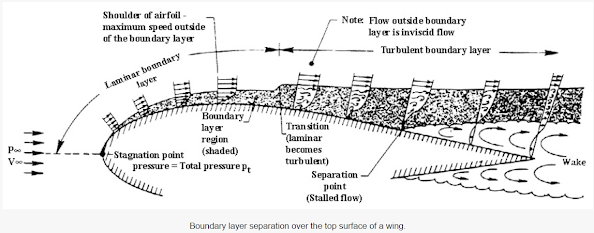
Figure 1: Annotated diagram illustrating fluid movement over an airfoil. Sourced from Aerospace Engineering Blog.
Theory
Fluid traveling closely to an object is subject to the no-slip condition (the fluid has zero velocity relative to the object) because of the high decelerating effects from its viscosity. Farther away from the
